Laser Tattoo Removal on Dark Skin: What Are the Risks?
What are the risks of tattoo removal on dark skin? Learn the key precautions and how the PicoWay® laser supports safe, adapted treatment at Ray studios.

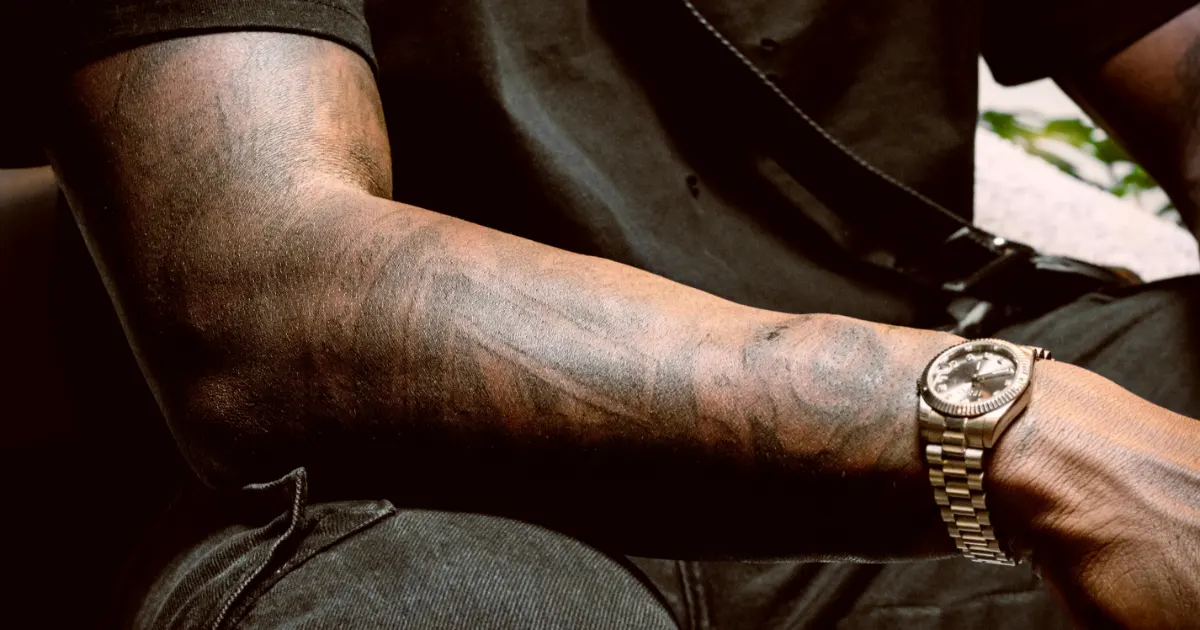
Laser tattoo removal is today the reference method for fading a tattoo gradually and in a controlled way. Thanks to modern technologies such as the PicoWay® picosecond laser from Candela, it is now possible to treat all skin types, including dark skin.
However, one question comes up very often among customers: is laser tattoo removal riskier on dark skin?
The answer is nuanced. Yes, dark skin has biological specificities that call for an adapted approach. But no, tattoo removal is not dangerous when it is carried out with the right technology, by trained skin therapists using correct laser settings in a controlled environment.
Understanding these risks is mainly about understanding the mechanisms involved and knowing how to anticipate them.
Why dark skin reacts differently to the laser
The main difference between light skin and dark skin lies in the concentration of melanin.
Melanin is a natural pigment produced by melanocytes. It protects the skin against UV, but it also plays a central role in how the skin interacts with the laser.
The key point is this: the laser targets pigments according to their capacity to absorb light, without distinguishing where that pigment comes from.
On dark skin:
- the melanin concentration is higher
- melanin can absorb part of the laser energy
- this absorption can generate a stronger skin response
This means the energy delivered must be perfectly controlled to avoid excessive stimulation of the skin.
The main risks of tattoo removal on dark skin
The risks exist, but they are today well known and well managed when an adapted protocol is applied.
1. Post-inflammatory hyperpigmentation
This is the most frequent risk.
After a laser session, the skin may react by producing more melanin, which leads to the appearance of darker areas.
This phenomenon is directly linked to the inflammation induced by the treatment.
Why it happens
Dark skin has more reactive melanocyte activity. When it is stimulated (inflammation, heat, aggression), it can respond with an overproduction of pigment.
Is it permanent?
In the majority of cases, this hyperpigmentation is temporary. It fades gradually over a few weeks to a few months, especially if the skin is properly protected and monitored. Individual results vary.
2. Hypopigmentation
Conversely, some areas may become lighter.
This phenomenon corresponds to a temporary disturbance of the melanocytes, which produce less melanin.
A rarer reaction, but a longer one
Hypopigmentation is less frequent than hyperpigmentation, but it can take longer to disappear.
A gradual recovery
In most cases, pigmentation returns gradually, but this can take several months, or even longer depending on the customer.
3. Burns and skin lesions
When the laser is set incorrectly, excessive energy can be absorbed by melanin, causing too great a rise in temperature.
Possible consequences
- significant redness
- blisters
- crusting
- scarring in the most severe cases
A largely avoidable risk
These complications are rare today and are generally linked to:
- unsuitable technology
- incorrect settings
- a lack of expertise
4. Slower and sometimes uneven progress
On dark skin, the skin therapist often adopts more conservative settings to protect the skin.
Consequence
- a treatment that is sometimes longer
- more gradual progress
- fading that is sometimes less even if the protocol is not properly managed
Why these risks are well managed today
These risks are not inevitable. They are now greatly reduced thanks to the evolution of technologies and protocols.
1. The choice of laser: PicoWay® from Candela
The PicoWay® is particularly well suited to dark skin.
Reduced thermal effect
Thanks to its ultra-short pulses:
- the energy is delivered very quickly
- thermal diffusion is limited
- inflammation is reduced
This lowers the impact on melanin.
A key wavelength: 1064 nm
This wavelength shows low absorption by melanin, which makes it possible to:
- target the tattoo pigments effectively
- limit stress on the surrounding skin
This is a fundamental element in treating higher phototypes.
2. The importance of a structured protocol
Technology alone is not enough.
The Ray Tattoo Profile (RTP®)
The RTP® makes it possible to assess precisely:
- the phototype
- skin sensitivity
- the nature of the tattoo
Above all, it makes it possible to: project the number of sessions and anticipate how the skin will react.
The RsAP® protocol
The RsAP® protocol is based on continuous adaptation of the treatment.
At each session, the skin therapist adjusts:
- the intensity
- the pace
- the strategy
According to:
- the skin response
- how the pigment is changing
- healing
This gradual approach is essential to keep the treatment safe.
3. The role of the skin therapist
Tattoo removal on dark skin cannot be standardised.
Each session must be personalised according to:
- how the skin reacts
- tolerance
- the progress of the treatment
It is this fine adaptation that makes it possible to obtain good results while limiting the risks. Individual results vary.
Good practice for reducing the risks
The customer also plays an important role in the success of the treatment.
Before the session
- avoid any sun exposure
- do not treat tanned skin
- keep the skin well hydrated
After the session
- protect the area strictly from UV
- apply the recommended aftercare
- avoid irritation (rubbing, excessive heat)
These measures are essential for limiting pigmentation problems.
Conclusion
Tattoo removal on dark skin carries specific risks, mainly linked to the interaction between the laser and melanin.
These risks concern above all:
- pigmentation problems
- inflammatory reactions
But they are well managed today thanks to:
- the PicoWay® picosecond laser from Candela
- a structured protocol (RTP® + RsAP®)
- the expertise of the skin therapist
When it is carried out in the right conditions, tattoo removal is a safe, gradual and effective procedure, including on higher phototypes. Individual results vary.
To discuss your tattoo and your skin type, book an initial consultation at Ray studios. Our Full Remove plan gives you unlimited sessions at a single fixed price.
FAQ
Is laser tattoo removal dangerous for darker skin?
No, laser tattoo removal is not inherently dangerous for darker skin, but it does require a specific approach. The presence of melanin increases the risk of pigmentation changes if the treatment is not properly adapted. With technology such as PicoWay and a personalised protocol, these risks are now well controlled. The role of qualified professionals or skin therapists is essential to adjust the settings and ensure the safety of the treatment.
What are the most common risks?
The most common risks are pigmentation changes, particularly hyperpigmentation and hypopigmentation. These reactions are usually temporary and related to the inflammation caused by the laser. Effects such as redness or blistering may also occur, but they are generally short-lived when properly managed. Following the treatment protocol helps minimise these effects under the supervision of qualified professionals or skin therapists.
Can complications be completely avoided?
It is impossible to guarantee the complete absence of reactions, as each skin responds differently. However, risks can be significantly reduced by using appropriate technology and following a precise treatment protocol. Adhering to pre- and post-treatment guidelines is also essential. A gradual approach allows for better control of the skin’s response, under the supervision of qualified professionals or skin therapists.
Is tattoo removal longer on darker skin?
Yes, the treatment may take slightly longer. More cautious settings are used to minimise the risk of adverse reactions, which can require additional sessions. This slower approach helps preserve the skin and achieve a more even result. The extra time is therefore a safety-driven choice, managed by qualified professionals or skin therapists.
Are results as good as on lighter skin?
Yes, results can be very good on darker skin when the treatment is properly performed. Black pigments respond particularly well to laser treatment. Some colours remain more difficult to remove, but this applies to all skin types. The key factor is the quality of the treatment protocol and the expertise of qualified professionals or skin therapists.