Can a full colour tattoo be removed with laser?
Can a full colour tattoo be removed with laser? Which colours are toughest, how the wavelengths work and how sessions are projected at Ray studios. Individual results vary.

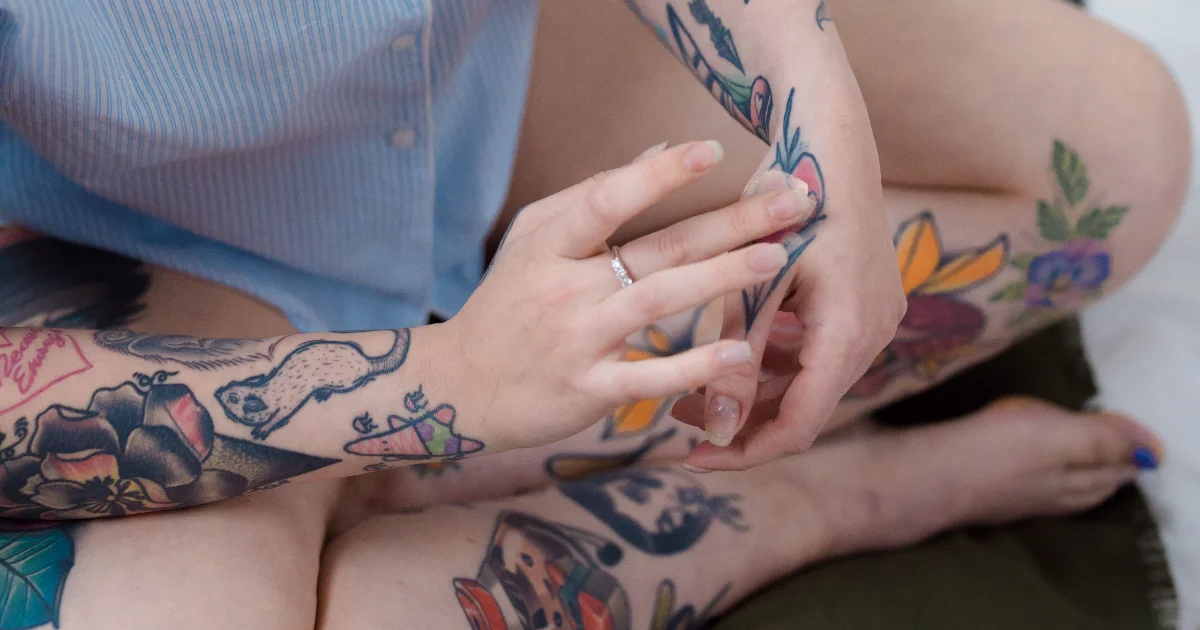
Yes, a tattoo made entirely of colour can be treated with laser, but it is more complex and generally takes longer than a black tattoo. Feasibility depends mainly on the colours present and on the laser used: each shade is only absorbed by a specific wavelength, so a multicoloured tattoo calls for a device able to cover a broad spectrum. Some colours, such as yellow or white, remain the most stubborn. Only an in-person assessment with a skin therapist can tell you what is realistic in your case.
Colour is one of the main factors that make tattoo removal more or less straightforward. A full colour tattoo is not "impossible" to remove, but it is not treated like a black design: it needs the right laser, often several wavelengths, more patience, and realistic expectations about the most resistant shades. This article explains why colour complicates matters, what role the laser plays, which colours cause the most difficulty and how the process is structured at Ray studios, a centre dedicated exclusively to laser tattoo removal.
Yes, a full colour tattoo can be treated
A fully coloured tattoo can be faded, and in some cases removed, provided a suitable laser is used and you accept a longer course of treatment than for a black design. Modern picosecond lasers, able to work across several wavelengths, can now target a wide palette of shades, whereas older devices were very limited on colour.
The important nuance to set out from the start is that "feasible" does not mean "easy" or "guaranteed 100% for every shade". Black and dark shades respond very well; other colours require more sessions, and a few particularly resistant pigments may only lighten partially. A full colour tattoo often combines both of these realities within the same design. Individual results vary.
That is why the real question is not "is it possible?" in the abstract, but "what is realistic for my particular tattoo?". The answer depends on the colours used, their depth, their age and your skin type, all elements that can only be judged during an in-person assessment.
Why colour makes removal more complex
Colour makes removal more complex because each pigment only absorbs one specific wavelength efficiently. The laser works by being taken up by the ink, which it then breaks into particles fine enough to be cleared by the body; if a colour absorbs the wavelength being used poorly, it is broken down little or not at all.
In practice, a laser that works well on black is not necessarily effective on green or red. Black absorbs the whole spectrum and therefore responds to most lasers, while each bright colour calls for a dedicated wavelength. A single-colour black tattoo needs only one wavelength, whereas a multicoloured tattoo requires several, applied in a targeted way depending on the area.
There is also a common pattern: over the course of the sessions, dark shades tend to go first, and it is not unusual for only warm pigments (yellows, oranges) or light ones to remain, which are harder to treat. The protocol is then adapted to target these residual colours specifically, which is why a coloured tattoo often needs finer and longer treatment than a black design of comparable size.
The decisive role of the laser: several wavelengths
For a full colour tattoo, the deciding factor is the laser's ability to deliver several wavelengths, because that is what allows the full spectrum of inks to be covered. A device limited to a single wavelength will treat black well but will leave several colours almost untouched.
At Ray studios, the PicoWay® picosecond laser works on four wavelengths (1064, 785, 730 and 532 nm), which allows a wide range of colours to be targeted:
- 1064 nm: black, dark blues and deep pigments.
- 785 nm: blues and greens, known to be difficult.
- 730 nm: a useful complement on certain blue-green shades depending on skin type.
- 532 nm: warm shades such as red, orange and yellow.
Beyond the number of wavelengths, picosecond technology delivers ultra-short pulses that break up the ink through an essentially photo-acoustic effect (a shock wave) rather than through heat. The resulting particles are finer and therefore easier to clear, which tends to improve results on colours while being gentler on the skin. It is this versatility that makes treating a multicoloured tattoo workable in the right conditions.
The most stubborn colours: yellow, white, pastels
Some colours remain distinctly harder to remove than others, and it is important to know this before starting. Yellow, white, pastel shades and certain light greens or blues absorb laser energy poorly and therefore require more sessions, with no guarantee of complete removal.
White deserves particular attention. Often used for details and highlights, it frequently contains titanium dioxide, a compound that can react to the laser and cause a colour shift: the pigment may darken, turning grey or black. This does not happen systematically, but it justifies a great deal of caution with light and white inks.
For that reason, it is advisable to carry out a test on a small area before treating a whole tattoo that is rich in light colours. This test allows the reaction of the pigments to be observed and the strategy to be adapted, particularly when the design contains white or pastel shades. The aim is to avoid unpleasant surprises and to adjust the protocol case by case.
How many sessions for a colour tattoo?
A coloured tattoo generally requires more sessions than an equivalent black tattoo, because the different shades do not fade at the same rate. Where a simple black design may need a few sessions, a dense multicoloured tattoo often calls for more, and the total depends heavily on the colours present.
As with any tattoo removal, sessions must be spaced several weeks apart to allow the skin to heal and the body to clear the fragmented pigments. This rhythm cannot be shortened without risk, which spreads the treatment of a colour tattoo over several months. The number of ink layers, the depth, the age of the tattoo and your skin type also affect the outcome.
No average found online can reliably predict your own course of treatment. Only an in-person assessment, which analyses each colour in your tattoo, allows the number of sessions to be estimated realistically and a clear objective to be set, whether that is complete removal or strong fading.
How it works at Ray studios
At Ray studios, removing a colour tattoo is a structured process carried out by trained skin therapists, from the first assessment to the last session. It starts with an assessment that identifies the colours present, their depth and their age, in order to determine which wavelengths to use and which strategy to adopt.
Following this analysis, you receive an RTP® (Ray Tattoo Profile) projection, a statistical estimate of the number of sessions needed. The process is framed by the RsAP® (Ray studios Advanced Performance) treatment protocol and relies on the PicoWay® picosecond laser and its four wavelengths, which allows the different shades in the design to be treated in a targeted way.
When the tattoo contains light colours or white, a test on a small area can be carried out to observe how the pigments react before treating the whole design. Your skin therapist then adjusts the protocol session after session, according to how the colours evolve, to progress safely towards the objective set with you.
Your initial consultation
The best way to find out whether your full colour tattoo can be removed is an initial consultation with a skin therapist at Ray studios. It is your chance to get an honest answer, tailored to your colours and your skin, rather than a generic estimate.
During this consultation, your skin therapist examines your tattoo, identifies the easiest and the most stubborn shades, assesses your skin type and gives you an RTP® projection of the number of sessions. Treatment is covered by the Full Remove plan: unlimited sessions at a single fixed price. You leave with a clear view of what is realistic, how the process runs and what result to expect.
Because the analysis of your tattoo's colours relies on correct laser settings and a controlled environment, this assessment cannot be done remotely: it requires an in-person examination. Book an appointment at one of our centres to meet a skin therapist and get your answers.
FAQ
Can a fully coloured tattoo really be removed?
Yes, a full-colour tattoo can be faded, and in many cases cleared, though treatment is more complex and takes longer than for a black one. Feasibility depends on the colours present and the laser used: since each shade is only absorbed by a specific wavelength, a multicoloured tattoo requires a device covering a broad spectrum, such as a multi-wavelength picosecond laser. Black and dark shades clear most readily, while some bright or pale colours take more sessions. "Feasible" does not mean "guaranteed 100% on every shade": only an individual assessment can establish what is realistic for your particular tattoo.
Which tattoo colours are hardest to remove?
Yellow, white, pastel shades and certain light greens and blues are the most stubborn, because they absorb laser energy poorly and require more sessions. Black and dark blues, by contrast, respond very well. White calls for particular caution: it often contains titanium dioxide, which can react to the laser by darkening, shifting towards grey or black. This does not happen systematically, but it justifies a test on a small area before treating a design with a lot of white or pale colours, so the pigment response can be observed and the approach adjusted.
Why do you need a multi-wavelength laser for colour?
Because each ink colour is only absorbed efficiently by a specific wavelength. A laser limited to a single wavelength handles black well but leaves several colours virtually untouched. Removing a multicoloured tattoo therefore requires a device capable of covering the full spectrum. The PicoWay® picosecond laser used at Ray studios operates across four wavelengths (1064, 785, 730 and 532 nm), targeting black and deep pigments, blues and greens, certain blue-green shades, and warm tones such as red, orange and yellow respectively. That versatility is what makes treating a full-colour tattoo viable under good conditions.
How many sessions does a coloured tattoo take?
A coloured tattoo generally takes more sessions than an equivalent black one, because the different shades do not clear at the same rate and the most stubborn colours need additional passes. Sessions have to be spaced several weeks apart to let the skin heal and the body clear the pigment, which spreads treatment over several months. The number of ink layers, the depth, the age of the tattoo and your skin type all shift the result too. No general average can reliably predict your own timeline: only an RTP® projection, built by a skin therapist after analysing each colour in your tattoo, gives a realistic estimate.