The Ultimate Laser Tattoo Removal Glossary: A to Z Guide
A detailed A to Z glossary of laser tattoo removal, with clear definitions of every mechanism and term, so you can understand your treatment and follow your results with confidence.

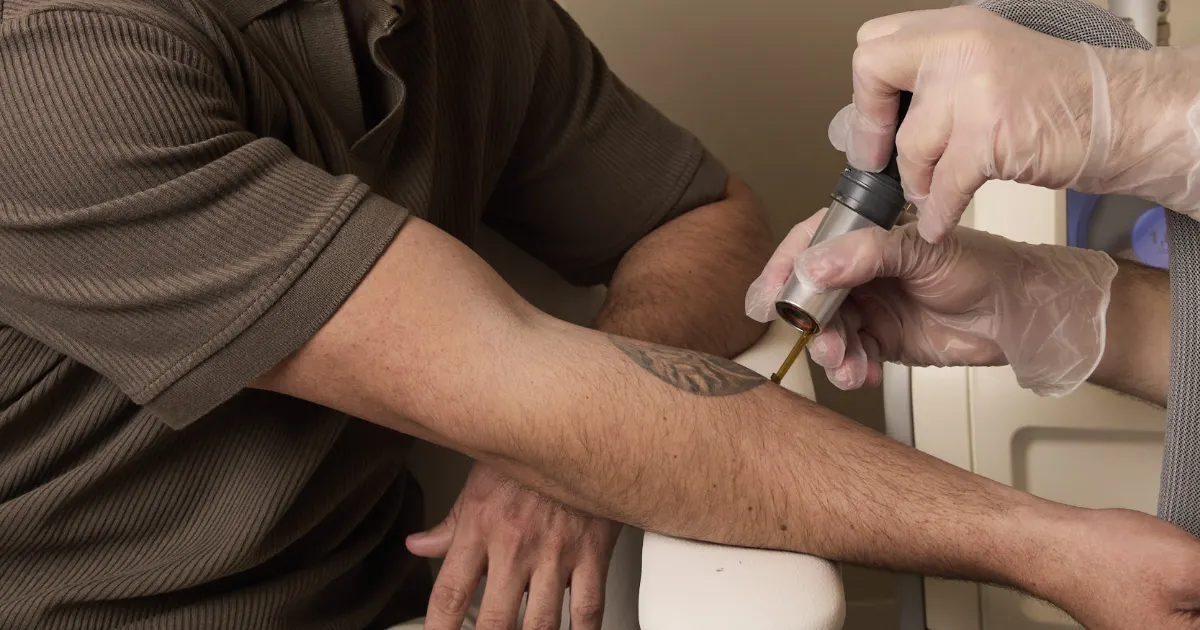
Laser tattoo removal looks simple from the outside, but it rests on a set of complex mechanisms combining physics, biology and skin science. Behind every session sit precise concepts: the interaction between the laser and the pigments, the response of the immune system, technical settings, individual skin characteristics.
For a customer, these terms can be hard to follow. This glossary was designed as a complete knowledge base for laser tattoo removal, bringing together:
- the fundamental scientific concepts,
- the technical terms used during your consultation,
- and the specific vocabulary developed by Ray studios.
The aim is to offer a reliable reference, both educational and technical, so you can understand the treatment better, interpret your results and build a coherent understanding of tattoo removal as a whole.
A
Selective absorption
Short definition: The ability of a pigment to absorb a specific laser wavelength.
Selective absorption is the central principle of laser tattoo removal. Every pigment has a specific optical signature, which means it absorbs certain wavelengths more efficiently than others. This property allows ink particles to be targeted precisely without significantly affecting the surrounding tissue. A good match between wavelength and pigment directly conditions how effective the treatment is and limits skin risks. This principle is the basis for choosing the right laser for each ink colour.
See also: Wavelength, Chromophore, Laser-pigment interaction.
Macrophage activity
Short definition: The role of macrophages in eliminating fragmented pigments.
Macrophage activity sits at the heart of how pigments are removed after each laser session. Once the ink particles have been fragmented, macrophages engulf them and carry them to the lymphatic system for elimination. How efficient this activity is varies with the customer's immune status, hydration level, physical activity and the interval between sessions. A well supported immune system favours faster and more complete elimination of pigments, which can reduce the total number of sessions needed. Individual results vary.
See also: Macrophages, Phagocytosis, Lymphatic drainage.
Parameter adaptation
Short definition: Adjusting the laser settings according to the observed skin response.
Parameter adaptation refers to the skin therapist's ability to modify the treatment settings between sessions, including fluence, spot size, pulse frequency and wavelength, according to the response observed. This skill is what separates expert treatment from a standardised one. It takes into account how the tattoo is evolving, the customer's skin tolerance, any side effects noted and the goals of the treatment.
See also: Fluence, Spot size, Progressive strategy.
Local pain relief
Short definition: The methods used to reduce discomfort during the session.
Local pain relief covers all the techniques used to minimise the discomfort felt during a laser tattoo removal session: topical numbing cream applied 45 to 60 minutes before the session, and skin cooling with a cold air jet during treatment. The choice of method depends on the size of the tattoo, its location and the customer's pain threshold.
See also: Cryotherapy, Skin tolerance.
Angiogenesis
Short definition: The formation of new blood vessels supporting healing.
Angiogenesis is the natural process by which the body creates new blood vessels from existing ones. In tattoo removal, this plays a key role in healing after treatment and in transporting the macrophages that clear pigment debris. Areas of the body closer to the heart benefit from better angiogenesis, which explains their faster response to treatment.
See also: Lymphatic drainage, Microcirculation, Central zone.
Exclusive treatment tracking app (Ray studios)
Short definition: A digital tool reserved for Ray studios customers to view how their tattoo removal progresses session after session.
The exclusive Ray studios treatment tracking app is a proprietary tool available only to customers treated in Ray studios centres. It documents and displays the progress of your tattoo removal across sessions, giving a clear, chronological view of the changes achieved. It is a concrete support for your follow-up, helping you understand where your treatment stands and why the protocol is structured the way it is. It forms part of the wider RsAP® approach, where traceability and individual follow-up are pillars of the protocol.
See also: RsAP®, RTP®, Pigment fading.
Pigment fading
Short definition: The gradual reduction in the intensity of the tattoo across sessions.
Pigment fading is the visible, cumulative reduction in the colour intensity of a tattoo. The process is not linear: some sessions produce more marked effects than others, depending on the quantity of pigment remaining, the customer's biological response and the interval respected between treatments. It is the main indicator used to follow the treatment. Individual results vary.
See also: Progressive lightening, Pigment density, RTP.
B
Skin barrier
Short definition: The protective function of the skin, temporarily altered after laser treatment.
The skin barrier is the set of physical, chemical and biological mechanisms that protect the body from outside aggressions. After a laser tattoo removal session, this barrier is temporarily weakened, which calls for particular precautions: careful hygiene, strict sun protection, suitable hydration and avoiding any irritating product.
See also: Keratinocytes, Healing, Skin tolerance.
Pigment biocompatibility
Short definition: The degree to which a pigment is compatible with biological tissue.
Pigment biocompatibility assesses how well a tattoo pigment is tolerated by the body without causing an inflammatory, allergic or toxic reaction. It varies with the chemical composition of the pigments and directly influences the risk of complications during removal: some poorly biocompatible pigments can release toxic substances when they fragment.
See also: Organic pigment, Inorganic pigment, Xenobiotic.
Whitening (frosting)
Short definition: The immediate, temporary white reaction visible after the laser passes.
Whitening, known as frosting, is an immediate skin reaction that appears as a white-grey colouring on the surface of the treated tattoo within seconds of the laser pulse. The phenomenon is linked to the rapid formation of microscopic gas bubbles (cavitation) resulting from the vaporisation of intracellular water. Frosting is a positive indicator: it confirms that the laser has interacted with the pigments.
See also: Cavitation, Photoacoustic effect, Fluence.
Thermal burn
Short definition: A rare skin injury resulting from excess laser energy.
A thermal burn is a rare but serious complication, occurring when thermal energy exceeds the tissue's capacity to dissipate it. It can be caused by fluence that is too high, excessive overlap of laser pulses or the absence of effective skin cooling. Risk factors include a high phototype, tanned skin or an insufficient interval between sessions.
See also: Photothermal effect, Cryotherapy, Phototype.
C
Cavitation
Short definition: The formation of gas microbubbles responsible for the frosting visible after the laser pulse.
Cavitation is a central physical phenomenon in laser tattoo removal. The energy absorbed by the pigments causes almost instantaneous vaporisation of intracellular water, generating gas microbubbles that form and collapse within microseconds, creating shock waves that contribute to fragmenting the ink particles. The phenomenon is more marked with picosecond lasers.
See also: Frosting, Photoacoustic effect, Picosecond pulse.
Chromophore
Short definition: The molecular structure of the pigment responsible for absorbing laser light.
A chromophore is the part of a pigment molecule that selectively absorbs certain light wavelengths. It gives the pigment its colour and determines how it reacts to the laser. Knowing which chromophores are present in different inks makes it possible to anticipate the response to treatment and choose the optimal wavelength.
See also: Selective absorption, Wavelength, Absorption coefficient.
Healing
Short definition: The biological skin repair process, in several phases, after each session.
Healing after laser tattoo removal follows three phases: the inflammatory phase (day 1 to day 4) with redness and swelling; the proliferative phase (day 4 to day 21) with tissue reconstruction and maximum macrophage activity; and the remodelling phase (day 21 to day 90) with progressive elimination of the fragmented pigments. A minimum interval of 6 to 8 weeks between sessions is essential to let this cycle complete.
See also: Healing time, Angiogenesis, Macrophage activity.
Absorption coefficient
Short definition: A quantitative measure of a pigment's ability to capture laser energy.
The absorption coefficient quantifies how efficiently a pigment absorbs at a given wavelength. A high coefficient means little energy is needed to reach the pigment destruction threshold. A low coefficient means fluence must be increased, which can affect surrounding tissue.
See also: Fluence, Selective absorption, Pigment destruction threshold.
Initial consultation
Short definition: The required first step of assessment before any laser treatment.
The initial consultation is used to assess the characteristics of the tattoo (colours, depth, age), the customer's phototype, their history and their expectations. It is during this consultation that consent is obtained and the projected number of sessions is set. An inadequate consultation is one of the main causes of poor outcomes or complications in laser tattoo removal.
See also: Phototype, RTP, Tattoo assessment.
Cryotherapy
Short definition: The application of controlled cold to the skin to improve comfort and protect tissue.
In laser tattoo removal, cryotherapy refers to the use of a skin cooling system, most often a jet of pulsed air at very low temperature (–20°C to –30°C), applied at the same time as, or immediately before and after, the laser pulse. It allows higher fluences to be used while maintaining an optimal safety profile, and is particularly recommended for high phototypes.
See also: Local pain relief, Thermal burn, Phototype.
D
Pigment density
Short definition: The quantity of ink present per unit of skin surface.
Pigment density directly conditions the length and complexity of the treatment. It depends on the tattoo style (blackwork shows extremely high density), the tattooist's technique and the age of the tattoo. High density means more sessions and closer follow-up.
See also: Pigment saturation, RTP, Fluence.
Pigment degradation
Short definition: The fragmentation of ink particles under the effect of laser energy.
Pigment degradation is the central mechanism of tattoo removal. Under the effect of the laser pulse, large ink particles are broken into nanoparticles small enough to be engulfed by macrophages and cleared through the lymphatic system. The process involves two complementary mechanisms: the photothermal effect and the photoacoustic effect.
See also: Pigment fragmentation, Photoacoustic effect, Phagocytosis.
Optical scattering
Short definition: The dispersion of the laser beam within the skin layers as it penetrates.
Optical scattering describes how laser photons are deflected from their initial path as they travel through tissue. It reduces the energy density reaching target pigments at depth. It varies with wavelength (shorter wavelengths scatter more) and with the customer's phototype.
See also: Wavelength, Phototype, Fluence.
Lymphatic drainage
Short definition: The elimination of fragmented ink nanoparticles through the lymphatic system.
Lymphatic drainage is the final stage of pigment elimination. Once engulfed by macrophages, the nanoparticles are transported to the regional lymph nodes where the waste is filtered. Sufficient hydration, moderate physical activity and proximity to lymph nodes all favour this process.
See also: Macrophages, Central zone, Pigment washout.
E
Progressive lightening
Short definition: The visible, cumulative reduction of the tattoo across successive sessions.
Progressive lightening happens between sessions, during the lymphatic drainage phase. Its speed varies with phototype, anatomical location, ink composition and lifestyle habits. It does not follow a linear progression: plateaus are common, particularly with complex inks.
See also: Pigment fading, Pigment washout, Biological response.
Photoacoustic effect
Short definition: Mechanical fragmentation of pigments by shock wave, dominant in picosecond lasers.
When an ultra-short pulse strikes a pigment, energy absorption is so fast that the pigment undergoes explosive mechanical stress before the heat has had time to dissipate. This stress generates pressure waves that physically break the particles into very fine nanoparticles. Compared with the photothermal effect, it produces more complete fragmentation with less residual thermal energy.
See also: Picosecond pulse, Photothermal effect, Cavitation.
Photothermal effect
Short definition: The transformation of light energy into heat within the targeted pigment.
The photothermal effect is the mechanism by which absorbed light energy converts into heat, causing a rapid rise in the pigment's temperature. Dominant in nanosecond (Q-switched) lasers, it causes an abrupt expansion of the pigment, which fragments through thermal stress. It deposits more thermal energy in the surrounding tissue than the photoacoustic effect.
See also: Photoacoustic effect, Q-switched, Picosecond laser.
Erythema
Short definition: Post-treatment skin redness, a normal sign of the local inflammatory reaction.
Post-laser erythema results from the local vasodilation triggered by the normal inflammatory reaction. It can persist for 24 to 72 hours. Intense erythema persisting beyond 72 hours, accompanied by blisters or pain, should alert the skin therapist to a risk of burn or allergic reaction.
See also: Healing, Skin barrier, Aftercare management.
F
Individual factors
Short definition: Characteristics specific to the customer that influence removal results.
A distinction is made between non-modifiable factors, such as phototype, immune status and anatomical location, and modifiable factors, such as hydration, physical activity, sun exposure and smoking. Smoking is recognised as a factor that significantly reduces the effectiveness of tattoo removal by altering microcirculation and the macrophage response.
See also: Individual variability, Phototype, Biological response.
Fluence
Short definition: The energy delivered by the laser per unit of surface, expressed in J/cm².
Fluence is one of the most important laser settings. Fluence that is too low will not reach the pigment destruction threshold; excessive fluence risks causing thermal damage. It depends on the type of pigment, the wavelength, the spot size, the phototype and the age of the tattoo. Calibrating it correctly is the key to a treatment that is both effective and safe.
See also: Spot size, Pigment destruction threshold, Parameter adaptation.
Pigment fragmentation
Short definition: The reduction of ink particles into nanoparticles the body can clear.
Pigment fragmentation turns large pigment aggregates (0.1 to 10 μm) into nanoparticles a few tens of nanometres across, accessible to macrophages. Picosecond lasers produce finer and more even fragmentation thanks to the dominance of the photoacoustic effect.
See also: Pigment degradation, Phagocytosis, Picosecond laser.
Frosting
Short definition: Temporary whitening of the skin after the laser, an indicator of the reaction to treatment.
Frosting appears as a white-grey veil covering the treated area within seconds of the laser pulse, fading gradually over a few minutes to a few hours. Its intensity is rated on a scale and provides a valuable indicator: even, moderate frosting confirms good laser-pigment interaction.
See also: Whitening, Cavitation, Fluence.
G
Aftercare management
Short definition: The care protocol to follow after each removal session.
Aftercare management includes gentle cleansing of the treated area, application of a healing cream, mandatory total sun protection SPF 50+, and avoiding hot water, baths and swimming pools. Following these recommendations directly conditions the quality of healing. Poor aftercare is a frequent cause of complications.
See also: Healing, Skin barrier, Healing time.
Energy gradient
Short definition: Intentional variation of laser intensity across different areas of the tattoo.
The energy gradient is a strategy that modulates fluence across the different areas of a single tattoo. Areas of high pigment density may need a different fluence from lighter areas. This approach requires significant expertise and a precise reading of the tattoo before treatment.
See also: Fluence, Pigment density, Parameter adaptation.
H
Hyperpigmentation
Short definition: Temporary darkening of the skin linked to overproduction of melanin after treatment.
Hyperpigmentation is favoured by high phototypes (IV to VI), sun exposure and overly aggressive fluence. It generally resolves on its own within a few weeks to months. Prevention relies on strict sun protection and a wavelength choice suited to the phototype.
See also: Hypopigmentation, Phototype, Melanocytes.
Hypopigmentation
Short definition: Localised lightening of the skin through destruction of melanocytes.
Hypopigmentation is a more serious complication because it can be permanent. It results from the destruction of melanocytes by excessive laser energy or by sessions spaced too closely together. The risk is higher with older nanosecond technologies, excessive fluences and short intervals between sessions. Once established, permanent hypopigmentation has few options available.
See also: Hyperpigmentation, Phototype, Thermal burn.
K
Keratinocytes
Short definition: The main cells of the epidermis, involved in healing and in the skin barrier.
Keratinocytes make up around 90% of epidermal cells. They produce keratin and orchestrate the rebuilding of the skin barrier. Their rapid renewal cycle (28 days) is a favourable factor for recovery after laser. Excessive damage to keratinocytes is associated with the risk of scarring and hypopigmentation.
See also: Skin barrier, Healing, Hypopigmentation.
L
Picosecond laser
Short definition: The latest generation of laser technology, using ultra-short pulses.
The picosecond laser represents the current state of the art in tattoo removal. Its pulses, in the order of 10⁻¹² seconds and 100 times shorter than nanosecond lasers, maximise the photoacoustic effect at the expense of the thermal effect. The result: finer pigment fragmentation, less risk of burns and hypopigmentation, and better performance on stubborn colours such as green and blue.
See also: Q-switched, Photoacoustic effect, Picosecond pulse.
Wavelength
Short definition: The type of laser light that determines which pigments will be targeted and broken down.
The wavelength determines which colour of light is emitted and which pigments are able to absorb it. The main ones used on the PicoWay® by Candela: 1064 nm for black and dark inks, 532 nm for reds and oranges, 730 nm or 785 nm for blues and greens. No single wavelength can treat every colour, which is why multi-wavelength lasers are used for multicoloured tattoos.
See also: Selective absorption, Chromophore, Picosecond laser.
M
Macrophages
Short definition: Immune system cells responsible for eliminating fragmented pigments.
Macrophages are the main biological actors in tattoo removal. It was already macrophages that captured the ink particles when the tattoo was first done. The laser breaks these aggregates into particles small enough for fresh phagocytosis. Recent research shows a role for skin-resident macrophages in re-capturing pigments, which explains some of the recurrences observed.
See also: Phagocytosis, Lymphatic drainage, Macrophage activity.
Melanocytes
Short definition: Melanin-producing cells, to be preserved during treatment.
Melanocytes are an unintended collateral target in laser tattoo removal, particularly with certain wavelengths absorbed by melanin. Damage to them causes hypo- or hyperpigmentation. Protection strategies include adapting the wavelength, active skin cooling and reducing fluence.
See also: Phototype, Hypopigmentation, Hyperpigmentation.
N
Paradoxical darkening
Short definition: Unexpected darkening of certain pigments on the first laser pulse.
Paradoxical darkening is seen with certain light pigments containing titanium or iron oxides (white, flesh tones, some oranges). Under the laser, these pigments undergo a chemical reduction that turns them into darker forms. The phenomenon can be irreversible. A test pulse on a small area is strongly recommended before treating the whole tattoo.
See also: Pigment oxidation, Inorganic pigment, White (colour).
P
Phagocytosis
Short definition: The cellular process by which macrophages take in and clear ink nanoparticles.
Phagocytosis is only possible once particle size drops below a critical threshold (generally under 100–200 nm). This is why the quality of laser fragmentation directly conditions how effectively the body clears the pigment. The process takes several weeks, which explains the minimum required interval between sessions.
See also: Macrophages, Pigment fragmentation, Lymphatic drainage.
Phototype
Short definition: Classification of skin into 6 types according to melanin content and reaction to the sun.
Phototype (the Fitzpatrick scale, I to VI) is a fundamental decision-making parameter in tattoo removal. The higher the phototype, the greater the risk of pigmentation issues during treatment. Phototypes V and VI require particular expertise and, often, the exclusive use of 1064 nm.
See also: Melanocytes, Hyperpigmentation, Wavelength.
Q
Q-switched
Short definition: The historic nanosecond laser technology, the standard for tattoo removal before picosecond systems.
Q-switched Nd:YAG lasers (1064 nm / 532 nm) and Q-switched ruby lasers (694 nm) were the reference for tattoo removal for several decades. They remain effective on black inks. Their main limits are less fine fragmentation than picosecond systems and greater thermal deposition.
See also: Picosecond laser, Photothermal effect, Nanosecond.
R
Residual pigment
Short definition: Pigment that persists after a theoretically complete treatment.
Residual pigment results from pigments deeply embedded in the dermis, from highly resistant chemical compositions or from scarred areas. Managing it is one of the most complex challenges in tattoo removal. In some cases, a residual trace is accepted as the final result, in agreement with the customer.
See also: Pigment saturation, Pigment washout.
RsAP® - the exclusive Ray studios treatment protocol
Short definition: The proprietary Ray studios treatment protocol, developed to get the most from laser tattoo removal while preserving skin integrity.
RsAP® (Ray studios Advanced Performance) is the exclusive treatment protocol developed by Ray studios, based on the analysis of more than 60,000 cases treated. It rests on six interdependent pillars: an in-depth assessment, a personalised statistical projection through RTP®, laser treatment optimised by settings drawn from large-scale data analysis, structured aftercare, treatment delivered entirely by trained skin therapists, and continuous follow-up through the exclusive app. The protocol is updated regularly in line with the latest research and feedback from treatment experience. It claims a 30% efficiency gain in fading tattoos compared with conventional approaches. Individual results vary.
See also: RTP®, Tracking app, Picosecond laser, Parameter adaptation.
RTP® - Ray Tattoo Profile
Short definition: The exclusive Ray studios tool for a personalised statistical projection of the number of sessions needed to fade a tattoo.
RTP® (Ray Tattoo Profile) is the proprietary projection tool developed by Ray studios as part of RsAP®. It goes beyond a simple empirical estimate: it draws on a cross-analysis of the customer's individual profile and data from more than 60,000 cases treated. The variables included are ink type, colours present, pigment density, tattoo depth, phototype, anatomical location and the anticipated biological response. RTP® is established at the initial consultation and forms the basis of the relationship of trust between the skin therapist and the customer. It is dynamic and readjusted across sessions according to the actual response to treatment.
See also: RsAP®, Initial consultation, Individual variability, Pigment density.
S
Pigment destruction threshold
Short definition: The minimum level of laser energy required to fragment a given pigment effectively.
Below this threshold, the laser heats the pigment without fragmenting it. Above it, fragmentation is effective. This threshold is specific to each pigment-wavelength combination and can vary with the depth and chemical composition of the ink.
See also: Fluence, Absorption coefficient, Parameter adaptation.
Spot size
Short definition: The diameter of the laser beam at the skin surface, influencing penetration and effective fluence.
Spot size is expressed in millimetres. A larger spot size allows better penetration at depth because it reduces the relative scattering of the beam. It is adjusted in combination with fluence to reach the pigment destruction threshold at the desired depth.
See also: Fluence, Optical scattering, Energy gradient.
T
Skin tolerance
Short definition: The individual ability of the skin to take laser treatment without complication.
Skin tolerance depends on phototype, current treatments (isotretinoin, photosensitising products), healing history and any past skin reactions. It is reassessed at each session, because skin that tolerates treatment well at the start can become more reactive as sessions go on.
See also: Skin barrier, Phototype, Individual factors.
V
Individual variability
Short definition: Differences in response to treatment between customers following similar protocols.
Two people with apparently identical tattoos can have radically different responses. This variability results from genetic differences in immune response, microcirculation and regenerative capacity. It is the main reason why predictions of session numbers remain estimates.
See also: Individual factors, RTP, Biological response.
Vascularisation
Short definition: The density and quality of local blood circulation, influencing the response to treatment.
A well vascularised area quickly brings in the macrophages needed to clear pigments and speeds up healing. Smoking, which reduces peripheral vascularisation, is a documented cause of resistance to treatment. Regular physical activity can favour pigment elimination between sessions.
See also: Central zone, Peripheral zone, Lymphatic drainage.
W
Pigment washout
Short definition: The gradual, natural elimination of fragmented pigments by the body.
Washout happens in the weeks following each session, generally over a period of 6 to 12 weeks. It is during this period that most of the visible lightening occurs. The interval between sessions must allow washout to be as complete as possible before starting again.
See also: Lymphatic drainage, Macrophages, Progressive lightening.
X
Xenobiotic
Short definition: A chemical substance foreign to the body, such as tattoo pigments.
Tattoo pigments are xenobiotics by definition. They can contain potentially toxic compounds (aromatic hydrocarbons, aromatic amines, heavy metals) that may be released during laser fragmentation. European regulation (EU regulation 2020/2081) is progressively framing ink composition to limit toxicity.
See also: Pigment biocompatibility, Organic pigment, Inorganic pigment.
Y
Treatment yield
Short definition: The overall measured effectiveness of a treatment relative to the number of sessions carried out.
Treatment yield measures the degree of pigment fading achieved relative to the number of sessions completed. Tracking it makes it possible to identify early on the treatments that are stalling and to change strategy. It is a useful quality indicator for the continuous improvement of practice.
See also: RTP, Pigment fading, Parameter adaptation.
Z
Central zone
Short definition: Body areas close to the trunk, with better vascularisation and a faster response.
Central zones (chest, back, shoulders, abdomen) consistently show a better response than peripheral zones: higher vascular and lymphatic density, proximity to lymph nodes, better thermoregulation. Tattoos on the trunk need on average 20 to 30% fewer sessions than identical tattoos on the ankles or fingers. Individual results vary.
See also: Peripheral zone, Vascularisation, Lymphatic drainage.
Peripheral zone
Short definition: Body areas far from the trunk (hands, feet, ankles), responding more slowly to treatment.
Peripheral zones are the hardest to treat: less efficient microcirculation, slower lymphatic drainage, significant mechanical stress. Tattoos on the hands show a significantly higher rate of residual pigment. The protocol for these areas must anticipate a higher number of sessions.
See also: Central zone, Vascularisation, RTP.
How colours respond to the PicoWay® picosecond laser by Candela
Black - Optimal wavelength: 1064 nm
Black is the most reactive pigment. Its very broad absorption spectrum lets it respond to every wavelength, and particularly to 1064 nm, which is available for all phototypes. The response is generally excellent from the first sessions. Entirely black tattoos have the best outlook. Individual results vary.
Difficulty: ★☆☆☆☆
Red - Optimal wavelength: 532 nm
Good overall response at 532 nm, indicated for phototypes I to III. The chemical composition varies widely between manufacturers: some reds contain cadmium or mercury sulphide, which complicate treatment and increase the risk of allergic reaction. A test pulse beforehand is recommended.
Difficulty: ★★☆☆☆
Orange - Optimal wavelength: 532 nm
A variable response, less predictable than red, treated with the same 532 nm wavelength. Some oranges containing flesh-tone pigments can be prone to paradoxical darkening. A prior test is always advised. An orange-red combination in one tattoo may require two laser passes with different settings.
Difficulty: ★★★☆☆
Yellow - Optimal wavelength: 532 nm (partial effectiveness)
One of the hardest colours to remove. Its absorption coefficient at the available wavelengths is very low. Some yellows based on lead or bismuth are practically impossible to fade completely. The outlook for yellow should always be guarded and clearly explained to the customer in advance.
Difficulty: ★★★★☆
Green - Optimal wavelength: 730 nm (PicoWay®)
Historically difficult, green benefits on the PicoWay® from 730 nm, a wavelength specifically optimised for stronger absorption by green inks, with the shortest pulse duration on the system (250 ps) and a favourable safety profile. The response still varies with the ink formulation. Additional sessions are regularly needed and partial residual pigment is not unusual.
Difficulty: ★★★☆☆
Blue - Optimal wavelength: 730 nm or 785 nm (PicoWay®)
Blue responds well to the 730 nm and 785 nm wavelengths on the PicoWay®, both dedicated to blue and green inks. The 730 nm, the most recent version, offers stronger absorption and the shortest pulse duration, reducing the risk of post-inflammatory hyperpigmentation. Cyan and turquoise blues remain more resistant. The outlook is generally favourable in 6 to 12 sessions depending on intensity. Individual results vary.
Difficulty: ★★★☆☆
Purple - Optimal wavelength: 532 nm and 730/785 nm (PicoWay®)
Purple, an optical mix of red and blue, needs a two-wavelength approach to be treated effectively: 532 nm for the red component, 730 nm or 785 nm for the blue component. Depending on which dominates in the formulation, one or the other wavelength will be used first. The response is generally better than for green or yellow, but less predictable than for black.
Difficulty: ★★★☆☆
White - No standard wavelength is effective
The most complex and highest-risk colour to treat. Containing mainly titanium dioxide (TiO₂), white is prone to paradoxical darkening: the white pigment converts into a grey-black pigment under the laser, making the tattoo more visible than before. This reaction is often irreversible or very difficult to treat afterwards. The decision to treat a tattoo containing white must be discussed in depth with the customer, with a mandatory prior test.
Difficulty: ★★★★★
Common mistakes in tattoo removal
Expecting an immediate result: Tattoo removal is a gradual biological process. Most of the lightening happens between sessions, during the washout phase (6 to 12 weeks). Impatience leads to sessions booked too close together and, in the end, poorer results.
Not respecting the interval between sessions: An insufficient interval (under 6 weeks) does not give healing time to complete or macrophages time to clear the fragmented pigments. The result is paradoxical: less effectiveness and more risk of complications.
Going in the sun before and after treatment: Sun exposure before treatment increases epidermal melanin, multiplying the risk of hyperpigmentation. After treatment, it can cause lasting pigmentation issues. SPF 50+ protection is mandatory throughout the treatment.
Choosing an untrained or non-specialised centre: Laser tattoo removal requires trained skin therapists, correct laser settings and a controlled environment. An untrained operator can cause burns, scarring or irreversible hypopigmentation. Very low prices are often a sign of unsuitable equipment or a lack of training.
Stopping the treatment too early: Plateaus in lightening are normal and temporary. The final sessions, which deal with the most resistant residues, are often decisive for the end result. Stopping at that stage leaves residues that are difficult to pick up later.
Continuing to smoke: Smoking significantly reduces the effectiveness of tattoo removal by altering microcirculation and macrophage activity. Smokers need on average 30 to 40% more sessions for a comparable result.
Neglecting hydration and lifestyle: Insufficient hydration and no physical activity reduce the effectiveness of lymphatic drainage and macrophage activity. Keeping good habits between sessions is an often underestimated way to optimise your treatment.
The reviews and summaries to read first
- Gurnani et al. — “Comparing the efficacy and safety of laser treatments in tattoo removal: A systematic review” (JAAD, 2022).
One of the best entry points, because it compares the main laser modalities and their side effects. It concludes in particular that Q-switched and picosecond lasers are effective and safe for black tattoos, and that picosecond systems appear to have an advantage on certain colours such as blue, green and yellow. - Kassirer et al. — “Laser tattoo removal strategies: Part II: A review of the methods” (JAAD, 2024).
A recent and very useful review of methods, laser selection, technical settings, treatment combinations and safety. It reaffirms that lasers are today the most reliable and effective method for tattoo removal. - Khunger et al. — “Laser tattoo removal: laser principles and an updated guide for clinicians” (Lasers in Medical Science, 2022).
A practical review of the physical principles, wavelength choice, complications and recent updates. - Bäumler / Bauer et al. — “Developments in tattoo and tattoo removal toxicology” (Archives of Toxicology, 2025).
Worth reading for the toxicology and safety angle: by-products of irradiation, difficult pigments, allergic reactions, the question of TiO2 inks and so on. - “Non-laser treatment for tattoo removal” (Journal of Cosmetic Dermatology, review).
Useful for comparing non-laser alternatives: excision, dermabrasion, salabrasion, saline methods and others, generally with a higher scarring risk and less robust literature.
Landmark studies
- Bencini et al. — “Removal of tattoos by Q-switched laser: variables influencing outcome and sequelae in a large cohort of treated patients”
A large, frequently cited prospective cohort on the prognostic factors in Q-switched tattoo removal. It shows that the response depends on variables such as colour, size, location, the age of the tattoo and certain individual factors. - Brauer et al. / JAMA Dermatology — “Treatment of Tattoos With a Picosecond Alexandrite Laser”
A landmark study that helped establish picosecond lasers, with the idea that they can fragment certain pigments more effectively while limiting some side effects thanks to lower fluences. - Randomised single-blind split study, nanosecond vs picosecond Nd:YAG (British Journal of Dermatology).
A direct comparative trial between nanosecond and picosecond lasers using a “split tattoo” design, useful for comparing relative effectiveness and real cost-benefit. - Picosecond Q-Switched 1064/532 nm Laser in Tattoo Removal (2021).
An open study on 34 participants, useful for real-world data on the safety and effectiveness of a picosecond/Q-switched 1064/532 nm device. - Recent studies on accelerated or combined techniques
Techniques such as R20 / R0, PFD patches, or the addition of acoustic waves or shock waves mainly aim to reduce total treatment time or improve clearance. The literature exists, but it is less consistent and often smaller than for conventional lasers.
Key takeaways: the 5 pillars of laser tattoo removal
- Selective absorption is the scientific foundation of the treatment: each pigment reacts to a specific wavelength. The choice of laser follows directly from that.
- Pigment fragmentation produces nanoparticles that can be cleared by macrophage phagocytosis and lymphatic drainage, a biological process that takes several weeks.
- Personalised adaptation comes before any standardised protocol: phototype, location, ink composition and individual biological response guide every decision.
- Respecting the interval between sessions conditions both the safety of the treatment and its cumulative effectiveness.
- Picosecond lasers represent the current state of the art, but their advantage only counts if the skin therapist has the expertise to use their full potential.
FAQ
Why do results vary so much from one customer to another?
The variability in results is explained by the combination of multiple factors: pigment type, depth, density, location, phototype, and biological response. The immune system plays a central role in pigment elimination, introducing a natural degree of variability.
Why is the picosecond laser considered more effective?
The picosecond laser uses a photoacoustic effect that fragments pigments more finely than older laser technologies. This precision allows for more effective elimination while reducing thermal effects, thereby improving skin tolerance and overall results.
Is tattoo removal a purely mechanical process?
No. The laser fragments the pigments, but their elimination depends entirely on the body. Tattoo removal is therefore both a physical and a biological process, which explains its progressive nature.
Why should laser tattoo removal sessions be spaced out?
Spacing allows the skin to heal and the immune system to eliminate fragmented pigments. Sessions that are too close together do not improve results and may increase risks.