How to remove a failed scalp micropigmentation tattoo
Failed scalp micropigmentation? See how PicoWay® laser removal at Ray studios fades pigment step by step, guided by trained skin therapists. Individual results vary.

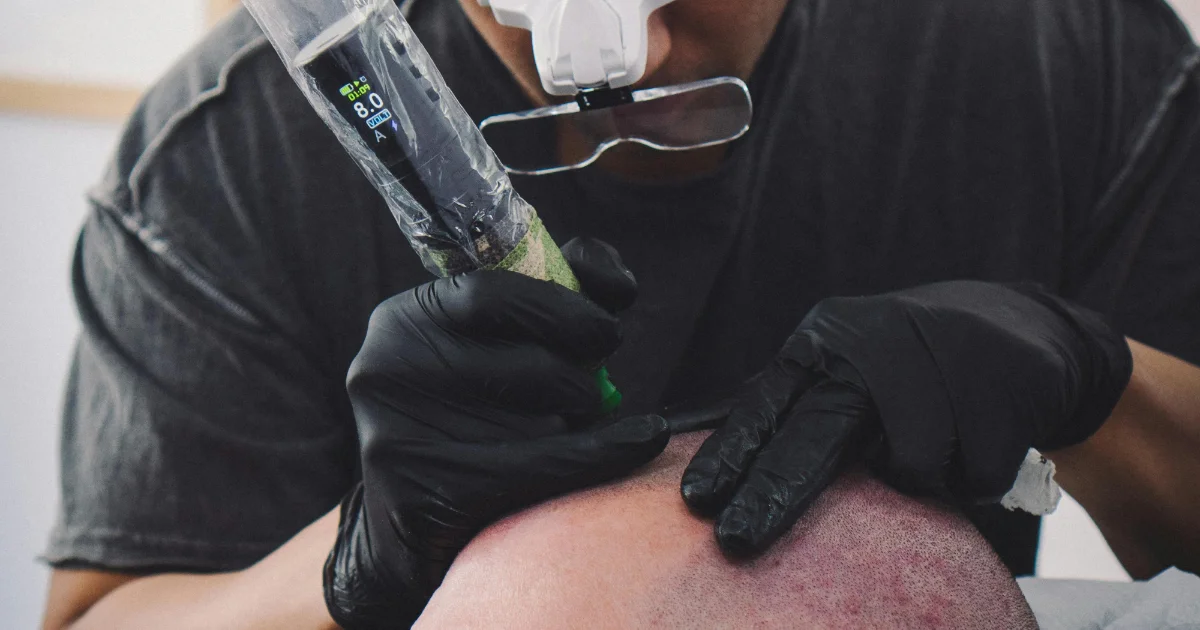
Scalp tattooing, also known as scalp micropigmentation or tricopigmentation, has grown considerably in recent years. The technique can recreate the illusion of hair density or redraw a hairline with a natural look… when it is carried out with real skill.
When something goes wrong, however, the result is immediately visible. Pigment that is too dark, dots that are too large, an artificial-looking implantation, asymmetry or a colour that ages badly… the flaws are numerous and often hard to correct.
One question comes up again and again: how do you remove a failed scalp tattoo without damaging the skin or compromising a future correction?
Today, one approach stands out as reliable and precise: picosecond laser removal with the PicoWay® by Candela, used within a personalised protocol.
Why scalp tattoos are difficult to correct
The scalp is a very specific area, both technically and aesthetically. Unlike a conventional tattoo, the aim is not decorative but illusionistic.
An extremely demanding optical illusion
Tricopigmentation relies on visually reproducing hair follicles.
For the result to look natural, each dot must be:
- extremely fine
- even
- positioned precisely
- perfectly matched to the skin tone
The slightest variation in size, colour or spacing becomes immediately noticeable.
Pigments that are often poorly suited
In poor results, we frequently see:
- pigments that are too dark or too saturated
- excessive density
- dots that are too large
- shades turning blue, grey or green
These flaws create a fixed, artificial look that is hard to correct without laser work.
An area under constant strain
The scalp is permanently exposed to:
- UV
- perspiration
- friction
- hormonal changes
These factors speed up pigment degradation and change its appearance over time.
The most common mistakes in tricopigmentation
Understanding the mistakes helps explain why removal is so often needed.
A hairline that is too sharp
An overly defined line creates an artificial effect that is immediately visible, especially in natural light.
Excessive density
Too many dots create a block effect instead of a diffuse one, which breaks the hair illusion completely.
The wrong shade
Some inks age badly and take on cool or dull tones that are incompatible with a natural look.
Poorly controlled depth
Pigment implanted too deeply is harder to correct and calls for more sessions.
Can it be corrected without removal?
In rare, very mild cases, a correction by touch-up may be considered.
In the vast majority of situations, though: removal is essential before any correction.
Why?
Because adding pigment over an incorrect base:
- accentuates the flaws
- makes the result heavier
- reduces the scope for correction
Laser removal: the only genuinely effective solution
Laser removal is now the reference method for correcting a failed scalp tattoo.
A precise, controlled mechanism
The laser delivers targeted energy that fragments the pigment into microscopic particles.
Those particles are then gradually cleared by the immune system.
A gradual approach
The treatment does not erase the pigment instantly. It lightens it session after session.
This allows:
- precise control of the result
- continuous adjustment
- gradual correction
A decisive advantage
Unlike abrasive or chemical methods:
the laser preserves the skin and leaves the door open to future tricopigmentation.
Why the PicoWay® by Candela is the reference
Not all lasers are suited to the scalp.
Ultra-precise picosecond technology
The PicoWay® works with extremely short pulses that fragment pigment mechanically.
This allows:
- a significant reduction in heat
- better precision
- better skin tolerance
Effective on dark pigments
The pigments used in tricopigmentation are generally black or dark, which makes them particularly responsive to this technology.
Preserving skin quality
The scalp needs to stay intact to allow:
- normal hair regrowth
- a future aesthetic correction
The PicoWay® helps strike this balance between effectiveness and safety. Individual results vary.
The Ray studios approach: a structured correction
At Ray studios, scalp tattoo removal rests on a complete, structured approach, not simply on the use of a laser.
The Ray Tattoo Profile (RTP®): structure from the start
The RTP® gives a full read of the tattoo:
- density
- depth
- colour
- implantation
Above all, it allows us to: project the number of sessions and set out a suitable correction strategy.
On the scalp, this projection is essential to avoid visible transitions and keep the look natural at every stage.
The RsAP® protocol: a treatment that evolves
The RsAP® protocol is built on continuous adjustment of the treatment.
At each session, your skin therapist adjusts:
- the laser intensity
- the spacing between sessions
- the overall progression
Based on:
- how your skin has responded
- how the pigment is breaking down
This approach matters particularly on the scalp, to avoid:
- patch effects
- visible contrasts
- irregularities
How many sessions are needed?
The number of sessions depends on:
- the density of the pigment
- its depth
- how old it is
On average:
- 3 to 6 sessions for significant lightening
- sometimes more for complete removal
The treatment is deliberately gradual to favour a natural result. Individual results vary.
Can tricopigmentation be redone afterwards?
Yes, and that is very often the end goal.
Removal allows you to:
- correct the mistakes
- even out the base
- start again on healthy skin
New tricopigmentation can then be carried out with a much more natural look.
The results: natural and precise
Gradual lightening
The pigment fades progressively, which allows the treatment to be adjusted at every stage.
Skin preserved
The texture and quality of the scalp are maintained.
An optimised aesthetic result
The aim is to work towards:
a natural, even and realistic look.
Mistakes to avoid
Adding pigment without correcting
This consistently makes the problem worse.
Using abrasive techniques
They can damage the skin irreversibly.
Choosing a centre without proper expertise
The scalp calls for specific expertise, correct laser settings, trained skin therapists and a controlled environment.
Conclusion
Removing a failed scalp tattoo is possible, but it needs a precise, gradual and carefully controlled approach.
The PicoWay® picosecond laser by Candela is currently the most effective and safest solution available.
At Ray studios, this technology sits within a structured protocol built on:
- the Ray Tattoo Profile (RTP®)
- the RsAP® protocol
- the expertise of our skin therapists
This approach helps correct a poor result while preparing the ground for the best possible aesthetic outcome. Book an initial consultation to discuss your scalp tattoo and the Full Remove plan, which covers unlimited sessions at a single fixed price. Individual results vary.
FAQ
Can a scalp tattoo be completely removed?
Yes, it is generally possible to fully or almost completely remove a scalp tattoo using a picosecond laser such as Candela’s PicoWay. The laser breaks down the pigments into very fine particles, which are then gradually eliminated by the body.
However, the result depends on several factors, including the density, depth, and quality of the original pigment. In some cases, significant fading may be sufficient to achieve a satisfactory visual correction. The treatment is always carried out progressively to preserve the quality of the skin.
Does scalp tattoo removal damage hair?
No, when performed under proper conditions, tattoo removal does not damage hair follicles. The laser specifically targets pigments in the skin and does not affect the hair root. Hair regrowth is therefore preserved. However, this also depends on the quality of the protocol and the technology used. An improperly performed treatment could lead to unwanted side effects, which is why it is important to rely on qualified professionals or skin therapists.
How long does the treatment take?
The treatment takes place over several months, as it requires multiple sessions spaced out to allow the skin to heal and the body to eliminate the pigments. On average, 3 to 6 sessions are needed, although this can vary depending on the case. Each session is relatively quick, but the overall process takes time. This gradual approach is essential to achieve a natural result and avoid any visible damage.
Can scalp micropigmentation be redone afterward?
Yes, this is often the goal in many cases. Tattoo removal helps create a more even and natural base. A new scalp micropigmentation procedure can then be performed under better conditions. However, it is essential to wait for complete healing before any new treatment. A qualified professional or skin therapist will advise you on the optimal timing to proceed.
Is the treatment painful?
Sensation varies from person to person, but it is generally well tolerated. It is often described as quick tingling or snapping sensations on the skin. The scalp can be more or less sensitive depending on the area. A numbing cream can be used to improve comfort. Modern technologies such as PicoWay significantly reduce discomfort thanks to their precision.