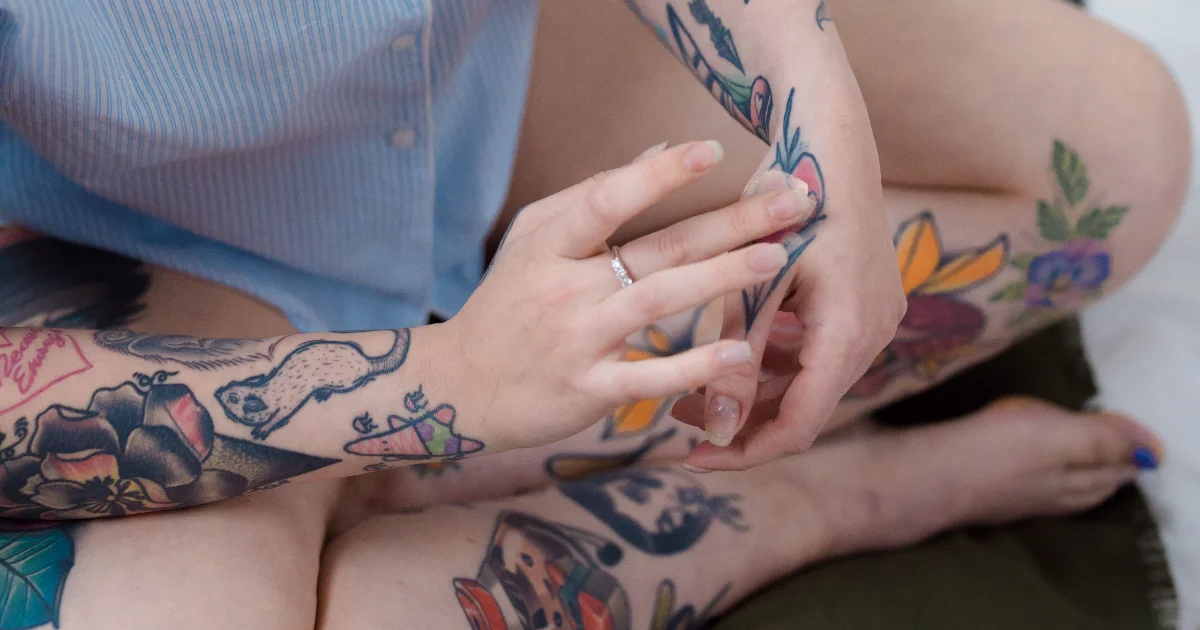
Can laser tattoo removal erase tattoos of any colour?
Today's laser technology can treat almost every tattoo colour, but not all colours respond with the same efficiency. Individual results vary.


How tattoo removal techniques have evolved to treat every colour
Recent progress in laser technology has widened the range of colours that can be treated. Today, most tattoo colours can be faded using advanced technology such as the picosecond laser used at Ray studios. Dark colours respond with a high degree of efficiency, while lighter shades sometimes need a greater number of sessions. Individual results vary.
Treatment settings according to colour
Each colour reacts differently to the laser. Tattoo removal works by fragmenting the ink pigments into tiny particles, which are then eliminated naturally by the body. The laser wavelength is chosen according to the colour of the ink and the skin.
At Ray studios we use the PicoWay® laser, one of the most capable for treating colour thanks to its four dedicated wavelengths:
- 1064 nm: for dark colours such as black, brown, dark blue and purple.
- 785 nm: for blue and green with a yellow undertone.
- 730 nm: for cooler blues and greens.
- 532 nm: for warm colours, in particular red, pink and orange.
With these wavelengths, the PicoWay® targets the pigments of each colour precisely in order to break them down effectively. Some shades such as yellow or white remain more difficult to treat, as their low absorption of the laser makes the fading process more complicated.
What to expect for each colour
Dark colours such as black, brown and red are the easiest to remove, because they absorb the laser energy well. Fully black tattoos, for example, tend to give very good results in a smaller number of sessions. Lighter shades usually call for a longer course of treatment: colours such as blue and green need more sessions, while white currently cannot be faded completely. Individual results vary.
Please note: a coloured tattoo is treated more quickly and more effectively when the colour contrasts well with the skin tone. For example, darker skin may require a higher number of sessions to fade light tattoos.
How many sessions for each type of colour?
Tattoo removal sessions should be spaced around eight weeks apart to allow the body to clear the pigments. Depending on the colours present in the tattoo, additional sessions may be needed, as lighter shades often require more laser passes.
Good to know: the length of a session can also vary with the size of the tattoo and the number of colours, as large or multicoloured areas often take more time.
Risks associated with removing coloured tattoos
In the controlled environment of Ray studios, with trained skin therapists and correct laser settings, risks are kept to a minimum. Coloured tattoos do not carry a higher risk of side effects than black tattoos. Redness or scabbing can appear in the days following treatment, but these settle when you follow the recommended aftercare. Your skin therapist will recommend a soothing cream and give you all the guidance you need to support healing.
Consultation and personalised support at Ray studios
Before starting treatment, the skin therapist assesses the tattoo and reviews the colours and the skin type in order to personalise the protocol. Using the RTP®, a statistical profile based on similar cases, we produce a projection of the number of sessions based on the colours and the specific features of your tattoo.
In short, advances in laser technology make it possible to treat the great majority of colours, although dark colours remain easier to fade. To get the best possible outcome, trained skin therapists, correct laser settings and consistent follow-up are essential, and every treatment is unique to the colours and the skin type of the customer.
Consultation and Personalised Support at Ray studios
Tattoo removal is a personalised process that varies with the colours in the tattoo, the depth of the pigments and the customer's skin type. At Ray studios, every customer receives a personalised assessment called the RTP®. This profile, based on statistical data from similar cases, allows us to build a made to measure treatment protocol.
At your initial consultation we also explain the Full Remove plan, which gives you unlimited sessions at a single fixed price. Each session comes with specific advice from your skin therapist on aftercare, to support healing as well as possible.
FAQ
How long does it take to see results?
The first results are visible after a few sessions, but complete removal may take several months, or even more than a year, depending on the complexity of the tattoo and the colour of the pigments.
Is laser tattoo removal painful?
The sensation varies depending on the area treated, the density of the tattoo, the colours present and individual sensitivity. Laser tattoo removal can be uncomfortable, but the pulses are very brief. Devices and protocols are put in place to limit discomfort and preserve the customer's comfort. At Ray studios, each session is tailored to the customer's tolerance threshold, with particular attention paid to skin safety rather than speed.
Is it possible to completely remove a tattoo?
Thanks to picosecond lasers and Ray studios’ expertise, complete tattoo removal is now a reality. All skin types, from the lightest to the darkest, can be treated safely.
For melanin-rich skin, the laser power is adjusted to preserve skin integrity, which may require a slightly higher number of sessions. There is one limitation: white and very light colours are not detected by the laser beam, making their removal impossible.
Despite this exception, results for other pigments are highly impressive.
Should I be concerned about side effects after my tattoo removal session?
The laser used for tattoo removal, unlike UV or X-rays, is not mutagenic: it does not alter DNA and is not associated with skin diseases. To ensure optimal use, here are the precautions to follow:
- Pregnancy and breastfeeding: laser treatment is not recommended during these periods.
- Eye protection: always wear protective goggles during sessions.
Serious side effects, such as an allergy to the pigment or a skin infection, are extremely rare. However, redness, blisters or scabs may appear, which is a normal skin reaction. These generally disappear within 48 to 72 hours. Individual results vary.
Tip: apply a moisturising cream to soothe the treated area, including over any blisters, without trying to pierce them.
Have questions or need assistance? Contact us on 01 82 88 44 04, write to us at contact@ray-studios.com, or send us a message on Instagram. We will be happy to respond quickly!
Does tattoo removal leave scars?
When performed properly using suitable technology such as PicoWay, tattoo removal generally does not leave scars. The laser preserves the skin’s structure. Risks mainly arise from incorrect protocols or failure to follow aftercare instructions. Proper follow-up by qualified professionals or skin therapists is therefore essential.
How much does a tattoo removal session cost?
Our pricing varies depending on the size of the tattoo. You can measure it by length and width using a ruler, then multiply both dimensions to calculate the surface area in cm².
Can a white tattoo be removed?
White pigment is very difficult to remove and does not respond well to laser treatment, which can make tattoo removal impossible for this colour.