Why a full picosecond laser protocol matters for removal
Picosecond laser is key to complete tattoo removal: finer pigment fragmentation, even on deep or coloured ink. Why Ray studios uses picosecond only, from the first session.

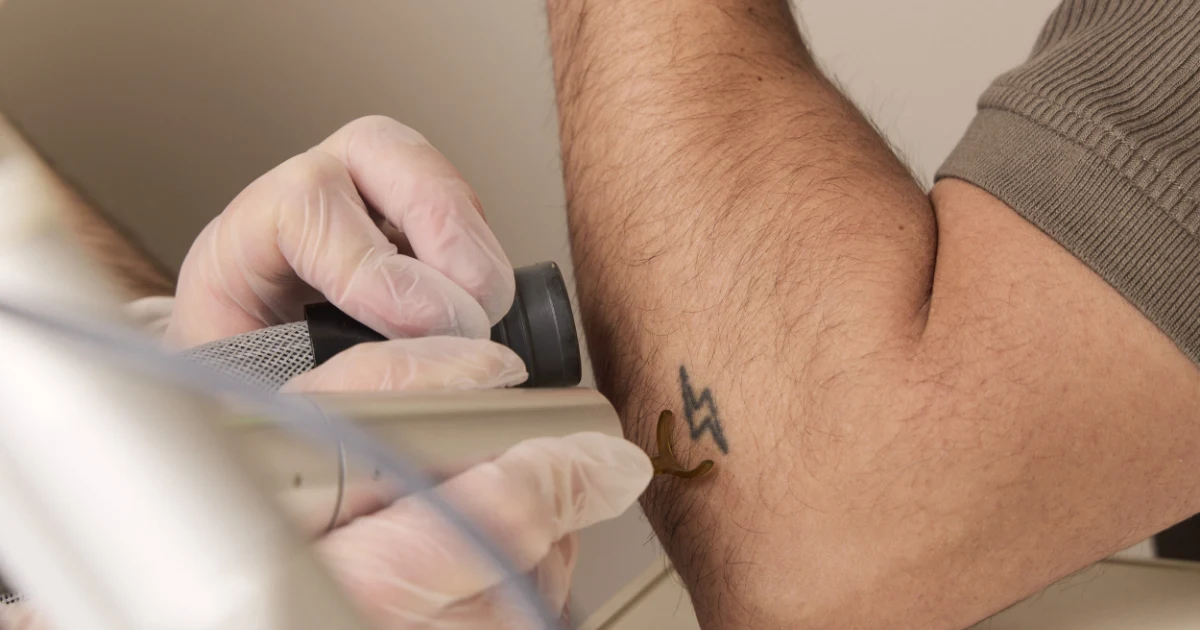
In tattoo removal, the consistency of the protocol matters as much as the technology used. Too often, customers start their treatment with a conventional laser (nanosecond), then finish with a picosecond laser hoping to improve the outcome. This hybrid strategy limits the real benefits of picosecond technology. For removal that is effective, safe and aesthetic, it is essential to follow a treatment carried out entirely with a picosecond laser, from the very first session.
At Ray studios, we have chosen to use picosecond only, because it is the approach that gives the best chance of an optimal result, on all skin types and inks.
Picosecond: a technology that tolerates no compromise
The term "picosecond" refers to the ultra-short duration of the laser pulse: one thousandth of a billionth of a second. This extremely brief action allows finer fragmentation of the pigments, making it easier for the immune system to clear them naturally.
Unlike the nanosecond laser, the picosecond laser:
- Breaks ink particles down into much smaller pieces
- Considerably reduces the thermal load on the skin
- Works more deeply while remaining gentler on the tissue
Alternating between a nanosecond and a picosecond laser prevents you from making full use of these advantages, because pigments that were poorly fragmented during the first sessions become harder to remove afterwards, even with a higher performing device.
The benefits of a 100% picosecond protocol
Maximum effectiveness from the first session
By choosing the picosecond laser from the start:
- The ink is properly fragmented from the first exposure
- The immune system can begin clearing the pigments effectively
- The total number of sessions is reduced, and each session becomes more productive
Less trauma to the skin
Nanosecond lasers are often more abrasive, causing:
- More redness and scabbing
- A higher risk of scarring or hyperpigmentation
Thanks to its more targeted action, the picosecond laser helps preserve the quality of the skin, even after several sessions. Individual results vary.
A better response on every ink
Some inks such as turquoise blue, red or yellow resist conventional lasers. With its specific wavelengths, the picosecond laser treats them far more effectively. Starting with a nanosecond laser creates an imbalance, leaving the ink more dispersed but not fragmented as it should be.
Why "finishing with picosecond" is not enough
It is tempting to save money by starting treatment with a cheaper laser, then "improving" the final sessions with a picosecond device. In reality:
- The gain is minimal, because the initial work prepared the pigments poorly
- Results are often less clear, slower to obtain and sometimes incomplete
- The final cost can be higher, because of the increased number of sessions and reduced skin quality
A hybrid protocol undermines the very logic of picosecond treatment, and does not allow you to draw the full benefit from it.
At Ray studios: a technology standard from the first shot to the last
We have made the clear and deliberate choice to offer treatments carried out entirely in picosecond, in order to support:
- A structured and consistent protocol
- Effective sessions, from the first one
- Better skin tolerance, even on sensitive areas
- Skin quality respected at every stage
Every customer receives a personalised assessment, support from trained skin therapists, and attentive aftercare follow-up.
Key points
- Effective tattoo removal rests on the consistency and quality of the protocol.
- Starting with a nanosecond laser weakens overall effectiveness, even if a picosecond laser is used later on.
- Only a 100% picosecond treatment, from the first session to the last, gives you the best chance of:
- Fewer sessions
- Fewer side effects
- Better results, obtained faster and lasting longer
- Fewer sessions
At Ray studios, we have made this standard the norm, for your safety, your comfort and your skin.
FAQ
Why shouldn't treatment start with a nanosecond laser?
Starting tattoo removal with a nanosecond laser limits the overall effectiveness of the protocol. This technology fragments the ink more coarsely, leaving residues that are more difficult to eliminate, even with a picosecond laser afterwards. As a result, the number of sessions required increases, and the final results may be less consistent. Furthermore, the first sessions determine the quality of healing; a less gentle approach can cause skin alterations. For safe, fast and effective treatment, it is preferable to use a picosecond laser from the very start.
Does picosecond technology really reduce the number of sessions needed?
Yes, in most cases, a picosecond laser can reduce the total number of sessions needed by 30 to 50% compared with older technologies. This is because it fragments the ink into much finer particles, which are easier for the lymphatic system to clear. Each session is therefore more productive, with results visible sooner. This reduction in sessions also means a shorter overall treatment and a more comfortable experience for the customer. Individual results vary.
Is picosecond technology really safer for the skin?
The picosecond laser heats the skin for a shorter time than other laser types, which considerably reduces the risk of burns, thick scabs or scarring. This allows better healing between sessions and reduces discomfort during treatment. Over the long term, this can also help support better skin quality, without irregularities or depigmentation. Individual results vary. This level of safety is particularly important on sensitive areas, such as the face or joints. This is why picosecond technology is now recommended by discerning skin therapists.
Is this technology effective on all ink colours?
Yes, the picosecond laser is recognised for its ability to treat a wide spectrum of colours, including those considered the most stubborn, such as green, turquoise, light blue or yellow. Thanks to the use of multiple wavelengths, it adapts to each type of pigment and its depth in the skin. Where traditional lasers fail or require a large number of sessions, the picosecond laser offers a more targeted and effective solution. It is therefore the reference option for multicoloured or complex tattoos. Individual results vary.