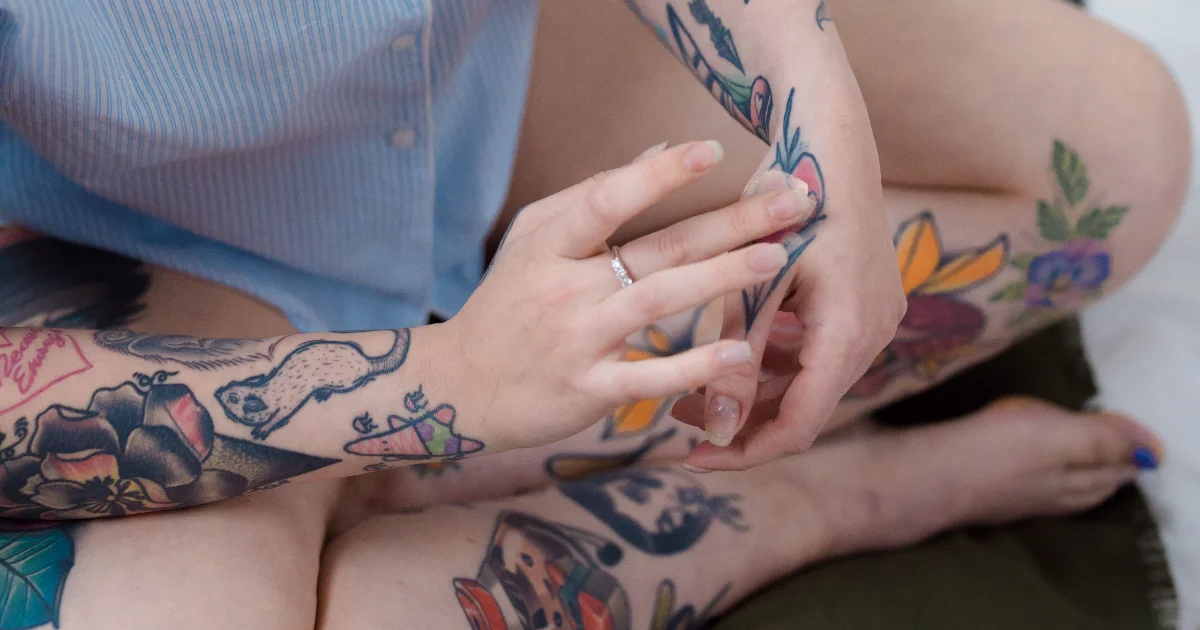
Can Laser Remove Every Tattoo Colour? The Truth on Inks
Thinking about tattoo removal on a colourful piece? Not every ink responds to the laser in the same way. Here is what to know before you start.

.webp)
Thinking about tattoo removal, but your tattoo is colourful? Not every ink responds to the laser in the same way. Some colours fade well, others… far less so. Here is what to know before you start.
How laser tattoo removal works: a question of contrast
Laser tattoo removal works through a principle called selective photothermolysis. The laser targets the ink pigments held in the skin, breaks them into small particles, and the body then clears them naturally through the lymphatic system.
For this to work at its best, the laser has to be able to "see" the pigment, which means there needs to be good contrast between the colour of the ink and the colour of the skin. The best laser technologies, such as the picosecond laser, are particularly effective at treating tattoos precisely and at depth.
The colours that fade best
Black tattoos are generally the easiest to remove. Black is the colour that responds best to the picosecond laser, which allows for quick and effective clearance.
The following colours also respond well to this technology:
- Dark grey or dark brown: these colours fragment easily and give good results.
- Dark blue and dark green: although these colours sometimes need a few extra sessions, the results obtained with the picosecond laser are generally very satisfying.
The picosecond laser, thanks to its ability to deliver extremely short and powerful pulses, is the best solution for treating these colours effectively.
The more difficult colours… and the truly stubborn ones
Some inks resist the laser more, but satisfying results are possible, especially with the picosecond laser. These are the colours that can be harder to remove:
- Red: although red can be harder to clear, the picosecond laser can achieve good results. This colour responds well to the technology, but may need a few extra sessions.
- Yellow: although this is one of the most resistant colours, results are nonetheless better than with older lasers. Do note that traces may remain after several sessions.
- Light green and turquoise: these colours can be slower to clear, and results vary depending on their depth and on how the skin responds.
- White: unfortunately, white cannot be removed with lasers. It is often impossible to treat, and in some cases it may even darken after treatment.
The difficulty with these colours comes from the way they respond to the light emitted by the laser. Some colours absorb light less effectively, while others reflect it back, which makes clearing them more complex.
Why do some colours hold on so tightly?
Inks that resist the laser are often difficult to clear for several reasons:
- The depth of the ink: the deeper the ink was placed in the skin, the harder it is to fragment effectively with the laser.
- The type of laser used: not every laser is designed to treat every colour at its best. The picosecond laser in particular has proven its effectiveness across a wide range of colours.
- How your skin responds: depending on your skin type, the removal process can be more or less responsive and effective. Lighter skin will generally respond better to treatment than darker skin, which can sometimes absorb more light.
Some inks contain more resistant and more stable pigments, which makes them harder to fragment with the laser. That said, with the right treatment, notable improvements can be achieved. Individual results vary.
Can everything still be removed?
Although it is sometimes difficult to clear certain pigments 100%, especially the stubborn colours, the picosecond laser considerably improves results, even on complex inks. Here is what to keep in mind:
- Some pigments can leave residual traces: even with the best technologies, traces may still be visible after several sessions, particularly with resistant colours.
- Multicoloured tattoos need more sessions: the more complex the tattoo, the more sessions will be needed to reach the best result. The number of sessions varies with the size, the colour and the depth of the tattoo.
- Partial fading is sometimes the outcome: on some areas of the body, tattoos may fade more, while light traces can remain on others.
Picosecond lasers still deliver quality results, even on the most difficult colours, while keeping the risk of skin damage low.
Why a personalised assessment matters
Before starting tattoo removal, it is essential to speak to a skin therapist. Your skin therapist will carry out a full assessment that includes:
- Identifying the colours present in your tattoo
- Reviewing your skin type: this allows the treatment to be adapted to how your skin responds and supports the best possible results.
- Setting up a protocol suited to your needs: every tattoo is unique, and the treatment is personalised for each customer, taking into account the specific characteristics of the skin and of the tattoo.
Careful follow-up, trained skin therapists, correct laser settings and a well established protocol help you get the most from tattoo removal, even on the toughest inks. Book an initial consultation to talk through your tattoo and the Full Remove plan, which gives you unlimited sessions at a single fixed price.
FAQ
Is black really easier to remove than other colours?
Yes, it is the most laser-reactive colour. Black absorbs all wavelengths, making it the simplest shade to fragment. It fades more quickly, with fewer sessions, even on darker skin. At Ray studios, black is often the first pigment to noticeably lighten. It provides an ideal base for effective removal or a future cover-up. Individual results vary.
Can yellow be completely removed?
It is difficult, but not impossible. Yellow is one of the most stubborn colours because it reflects light rather than absorbing it. However, with the latest generation picosecond laser, we achieve progressive results. Some traces may remain, but the lightening is still visible and useful for a cover-up. A tailored protocol is always established for these particular inks.
Can a white tattoo be removed with laser?
A white tattoo is considered impossible to remove reliably with laser. Unlike dark inks, white pigment does not react properly to laser energy, as it does not absorb it. In most cases, the laser has no visible effect or, on the contrary, causes permanent darkening, yellowing or a greyish appearance. The rare improvements observed are unpredictable and often incomplete. This is why skin therapists consider white tattoos non-removable and generally advise against any laser treatment on this type of pigment.
Which technology is most effective for coloured inks?
The picosecond laser is now the reference standard. It targets red, green, turquoise or light blue pigments precisely and without burning. Its pulse speed fragments the inks into finer particles, which are more easily eliminated by the body. At Ray studios, we use it exclusively in all our centres. This helps achieve clear, progressive results. Individual results vary.
Do multicoloured tattoos take longer to remove?
Yes, generally. Each colour reacts differently and requires a specific wavelength. This means more sessions and a more finely tuned protocol. But with a methodical approach and suitable tools, even removal is entirely achievable. Individual results vary. At Ray studios, we plan each treatment taking into account the full palette of the tattoo.