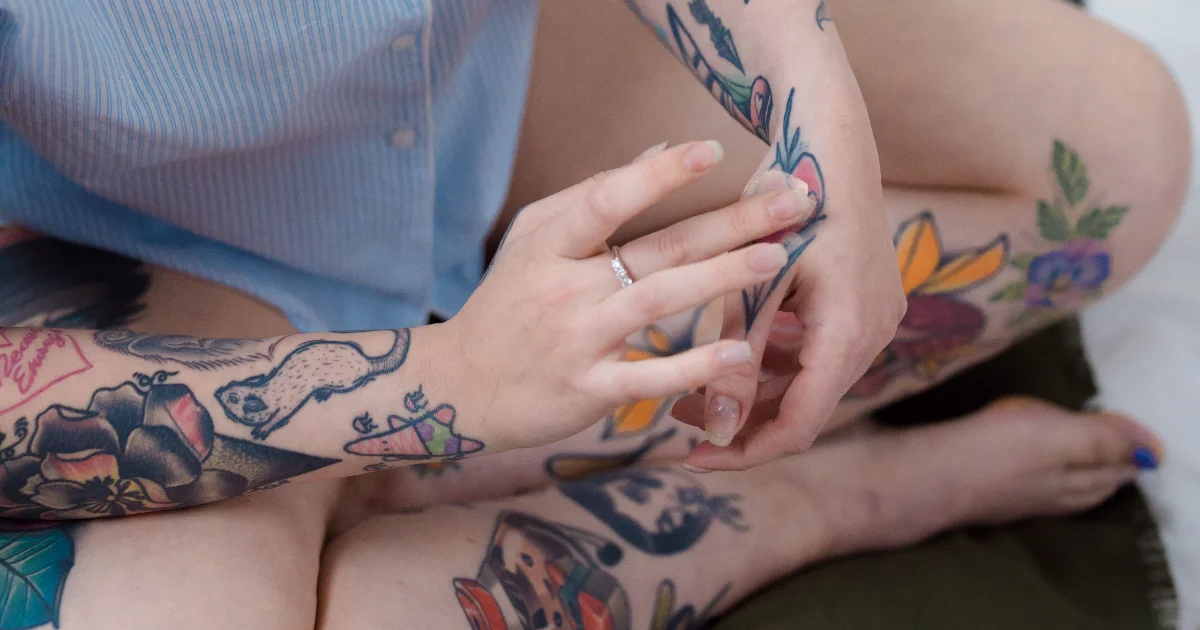
Blurred, Blown Out or Distorted Tattoos: Is It Normal?
Softer outlines, thickening lines, a design that shifts shape: a tattoo can change over time. Some of these changes are normal, but not all of them.

It is a very common worry among tattooed people: a design that was once crisp now looks less precise, as though it had blown out or lost its original shape. Lines thicken, details disappear, and the tattoo looks distorted or uneven.
At Ray studios, a centre specialising in laser tattoo removal, this question comes up every day at initial consultations. The answer is neither a straight yes nor a straight no: a tattoo can change in a perfectly normal way, but some transformations reflect specific mechanisms that are worth understanding.
A tattoo is never fixed
A tattoo is not an image printed on the skin. The pigments are deposited in the dermis, a living layer that has its own blood supply and ages over time. Even though ink is designed to last, its environment, your skin, is constantly changing.
Over the years, those changes can make a tattoo look less sharp, without anything having gone wrong when it was done.
Why a tattoo becomes blurred
Blurring is the most common effect. It is generally linked to the gradual spread of pigment through the dermis. Ink particles that were originally well contained can shift slightly over the years.
This is encouraged by:
- very fine lines,
- ink placed too deeply,
- thin or very mobile skin,
- skin ageing,
- repeated friction.
Visually, the outlines become less precise, the strokes thicken and the details start to merge.
A tattoo that "bleeds": a misleading impression
People often talk about a tattoo bleeding, but there is no ink running anywhere. What is happening is a slow, gradual spread of pigment. It is invisible at first, then becomes noticeable as the lines lose their definition.
This is particularly visible on minimalist tattoos, micro-tattoos and very detailed designs.
Distortion: when the skin changes
A tattoo can also become distorted without becoming blurred. This happens when the structure of the skin changes: weight variations, pregnancy, muscle development or natural ageing.
The design stays readable, but its proportions shift. Geometric and symmetrical designs are the most sensitive to this kind of change.
The role of the immune system
The body perceives pigments as foreign bodies. The immune system continuously tries to break them down and partially clear them. This mechanism is normal, but it varies a great deal from one person to another.
In some people, this immune activity contributes to a tattoo fading quickly or losing its evenness.
Sun and environment: aggravating factors
Sun exposure plays a major role in tattoos losing their definition. UV rays break down pigments and speed up skin ageing. Repeated unprotected exposure encourages blurring, distortion and uneven colour.
Add to that friction, perspiration and certain lifestyle habits that weaken the skin over the long term.
Is it always "normal"?
A slow, even and gradual change is generally considered normal. Some signs, however, should get your attention:
- rapid distortion,
- very pronounced blurring in a short space of time,
- sudden pigment loss,
- significant irregularities.
In these cases, a simple cosmetic touch-up is not always enough.
What the laser can do about blurring and distortion
At Ray studios, the tattoo removal laser is not used only to erase. It is very often used in a partial or corrective way:
- to treat spread pigment,
- to lighten a blurred area,
- to bring back readability,
- or to prepare for a correction or a cover-up.
The laser lets your skin therapist work precisely where the tattoo has degraded, while respecting the skin and how it changes. Individual results vary.
Key points
A blurred, blown out or distorted tattoo is not necessarily a failed one. In many cases it is a normal change linked to the skin, to time and to the environment. When that change becomes bothersome or fast, though, a specialist assessment helps you understand what is really happening under the skin.
At Ray studios, that understanding is the basis of everything our skin therapists do, so they can suggest gradual, controlled options suited to each situation.
FAQ
Is it normal for a tattoo to lose sharpness over time?
Yes, a certain loss of sharpness is common and generally normal. Over time, the skin changes, the dermis evolves, and pigments may slightly spread. This evolution is usually slow and uniform. It becomes problematic when the blurring appears rapidly, asymmetrically, or significantly affects the readability of the design. In such cases, a specialised assessment helps distinguish natural ageing from excessive pigment diffusion.
Why do fine-line tattoos deteriorate more quickly?
Fine-line or highly detailed tattoos leave very little room for natural evolution over time. Even minimal pigment diffusion quickly becomes noticeable. As the skin ages, lines naturally thicken and details begin to blend together. This phenomenon is even more pronounced on mobile or highly exposed areas of the body. It is not necessarily a tattooing mistake, but rather a structural limitation of the skin itself, which is often underestimated at the time the tattoo is done.
Can a distorted tattoo become sharp again?
A distortion caused by skin changes, weight fluctuations, skin laxity, or body transformations cannot be completely reversed. However, visual improvement is often possible. Depending on the situation, partial laser tattoo removal can help lighten certain areas, reduce visual heaviness, or restore better balance to the design before considering an aesthetic correction.
Is a touch-up always enough to correct a blurred tattoo?
No, and this is a common mistake. When the pigments have spread into the dermis, adding more ink can make the blurring worse and make the tattoo look heavier. In many cases observed at Ray studios, a laser lightening session beforehand is needed to “clean” the area before any touch-up. This progressive approach allows for a more precise and longer-lasting result. Individual results vary.
When should you consult a skin therapist?
It is advisable to book a consultation as soon as the tattoo becomes an aesthetic concern, changes rapidly, or when conventional options (touch-ups, cover-ups) seem limited. A specialised assessment allows you to understand precisely what is happening beneath the skin: pigment diffusion, ink depth, skin condition. At Ray studios, this assessment is essential to offer a realistic, safe solution tailored to each situation. Individual results vary.